
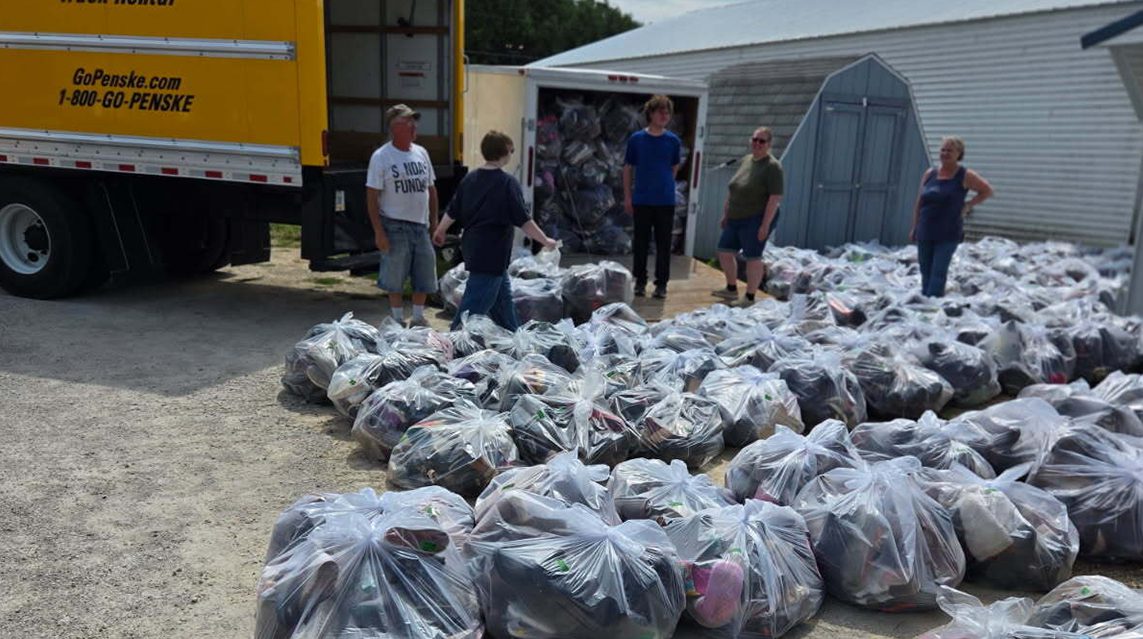

The Fayette County Food Shelf, a nonprofit food pantry in Fayette, Iowa, planned to try a shoe drive fundraiser once. It kept going: Funds2Orgs records show payments to the food shelf every year from 2017 through 2025, totaling $31,598. The two 2025 payments alone came to $10,000 for 710 bags of shoes.
In its reply to Funds2Orgs, the food pantry summed up the difference the funds made: “More quality food to give out.” Its path to a yearly food pantry shoe drive fundraiser offers practical lessons for other hunger-relief groups. Our nonprofit shoe drive fundraiser page explains how the program works.
The food pantry learned about shoe drives when it saw another group running one. It researched Funds2Orgs, read great things about the company, and kept the plan modest: it would “try it once.”
How one try became an ongoing project
By the time it replied, that single try had become, in the food pantry’s words, “an ongoing project for several years.” The payment records show how it grew. The yearly total stayed near $1,300 from 2017 through 2019, then rose every year from 2020 through 2025: from $2,360 in 2020 to $6,699.20 in 2024 and $10,000 in 2025.
Bag counts climbed from 113 in 2019 to 409 in 2024 and 710 in 2025. From 2019 through 2025, the payments covered 2,008 bags in all.
College students who sorted, banded, bagged, and loaded
Asked whether a moment or result stood out, the food pantry answered: “Seeing college students helping! From sorting, banding, bagging and then loading!” The reply also called it wonderful to work with young people and see them understand how to help the community.
Banding and bagging follow program rules: volunteers keep pairs together with a rubber band or tied laces and pack 25 pairs in each 33-gallon bag. For loading, our shoe drive fundraiser FAQ recommends two to three volunteers per 50 bags on pickup day. By that guideline, 350 bags, the size of one 2025 payment, call for about 14 to 21 people.
If there’s a college near your pantry, ask whether its students can take a sorting and loading shift. Our guide to volunteer recruitment strategies lists eight ways to find helpers.
Where the money goes and where the shoes go
In the same reply, the food pantry called the funds “…a great help for the food shelf.” Funds2Orgs pays by the pound after we receive and process the shoes, and the money and the shoes take different paths.
The shoes enter a resale network in the reuse economy where micro-entrepreneurs buy and resell them in their communities to earn a living. Our social enterprise explanation describes how that process works.
That gives a pantry a clear answer when donors ask what happens next: the money helps stock the shelves, and the shoes become inventory for small businesses.
Planning a food pantry shoe drive fundraiser
The Fayette County Food Shelf’s story suggests a simple plan. Learn from a group that has run a collection, then try one shoe drive fundraiser of your own. Ask supporters to donate gently worn, used and new shoes, and bring in student volunteers to sort, band, bag, and load. If it works, schedule the next one.
Explore how Funds2Orgs shoe drive fundraisers work before you set your first collection date.
When your pantry is ready, start your shoe drive fundraiser with a Funds2Orgs fundraising coach.
Don’t miss our webinars, eBooks, YouTube, or Facebook.
© 2026 Funds2Orgs. All Rights Reserved.